
You've Been Protesting on a Graveyard
Behind the Collector's office in Pune stands a 200 year old domed monument in a walled burial ground that nobody can name. The maps call it French tombs. The newspapers have called it German, and Jewish. The government called it missing. Here is what it actually is, and who lies in it.
These are, as far as anyone can trace, the oldest surviving British colonial monuments in Pune, six years older than St. Mary's Church, usually called the city's oldest British landmark. No older British structure appears to survive in the city today. Until this article, this walled plot had no story anyone could tell. It belongs on every heritage walk of Pune.
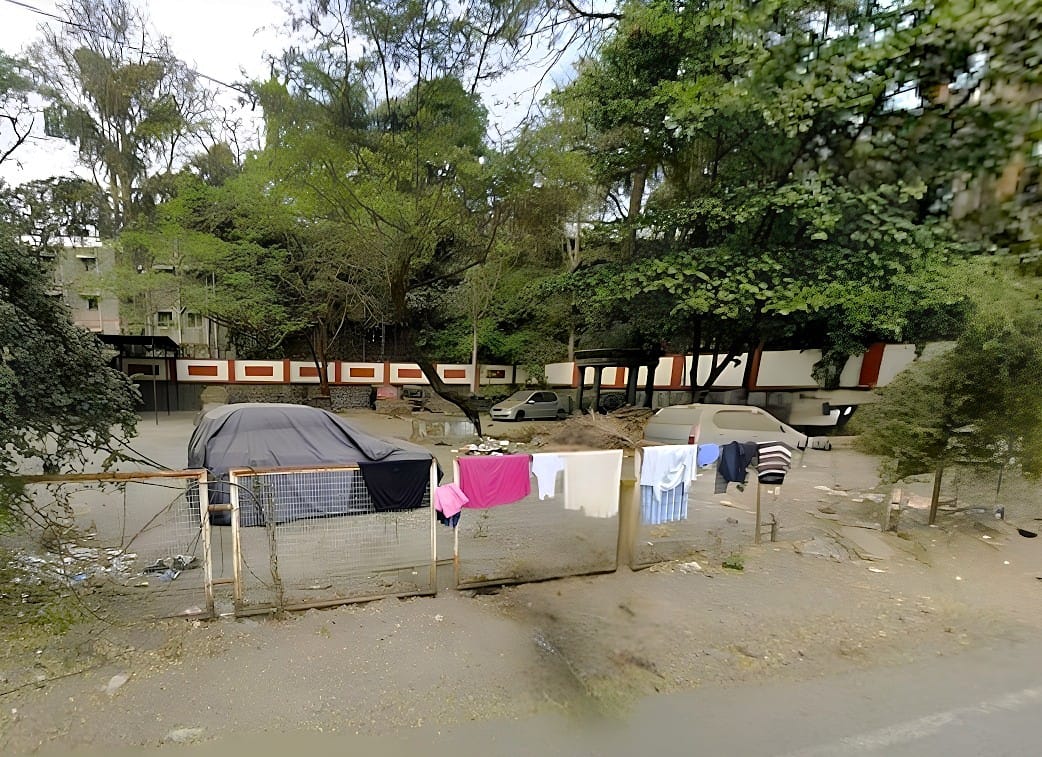
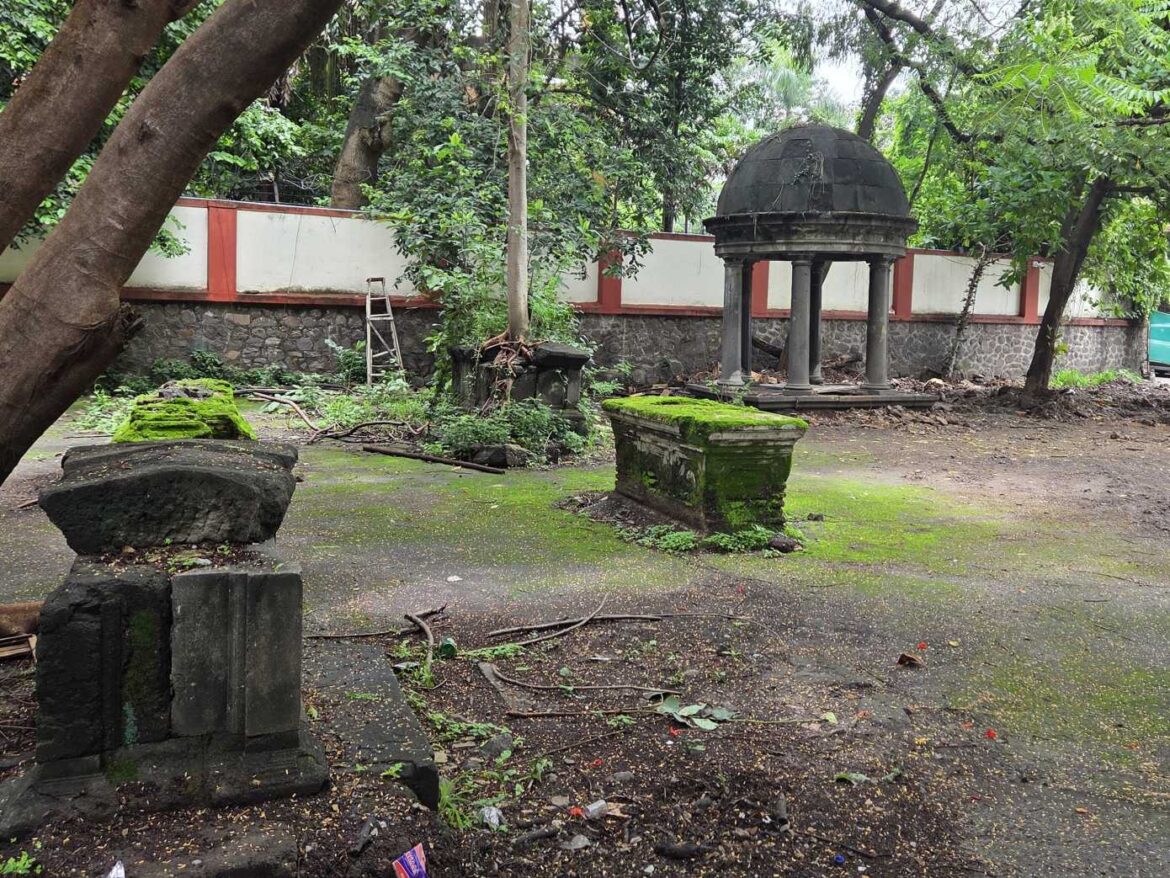
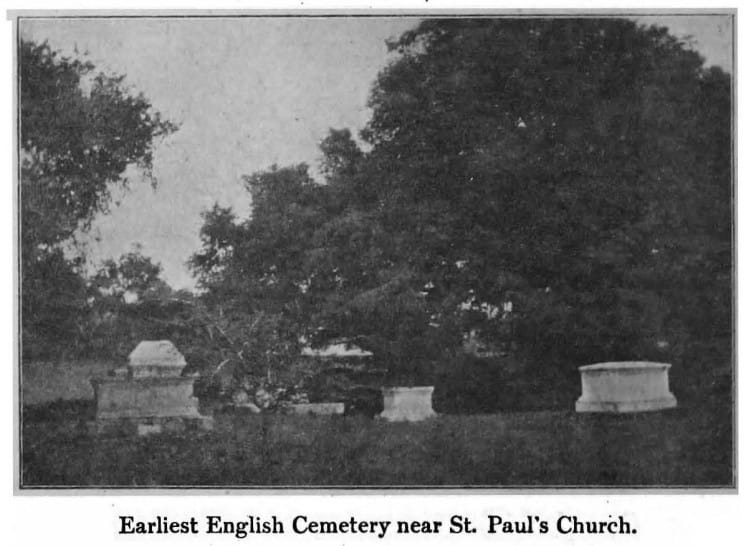
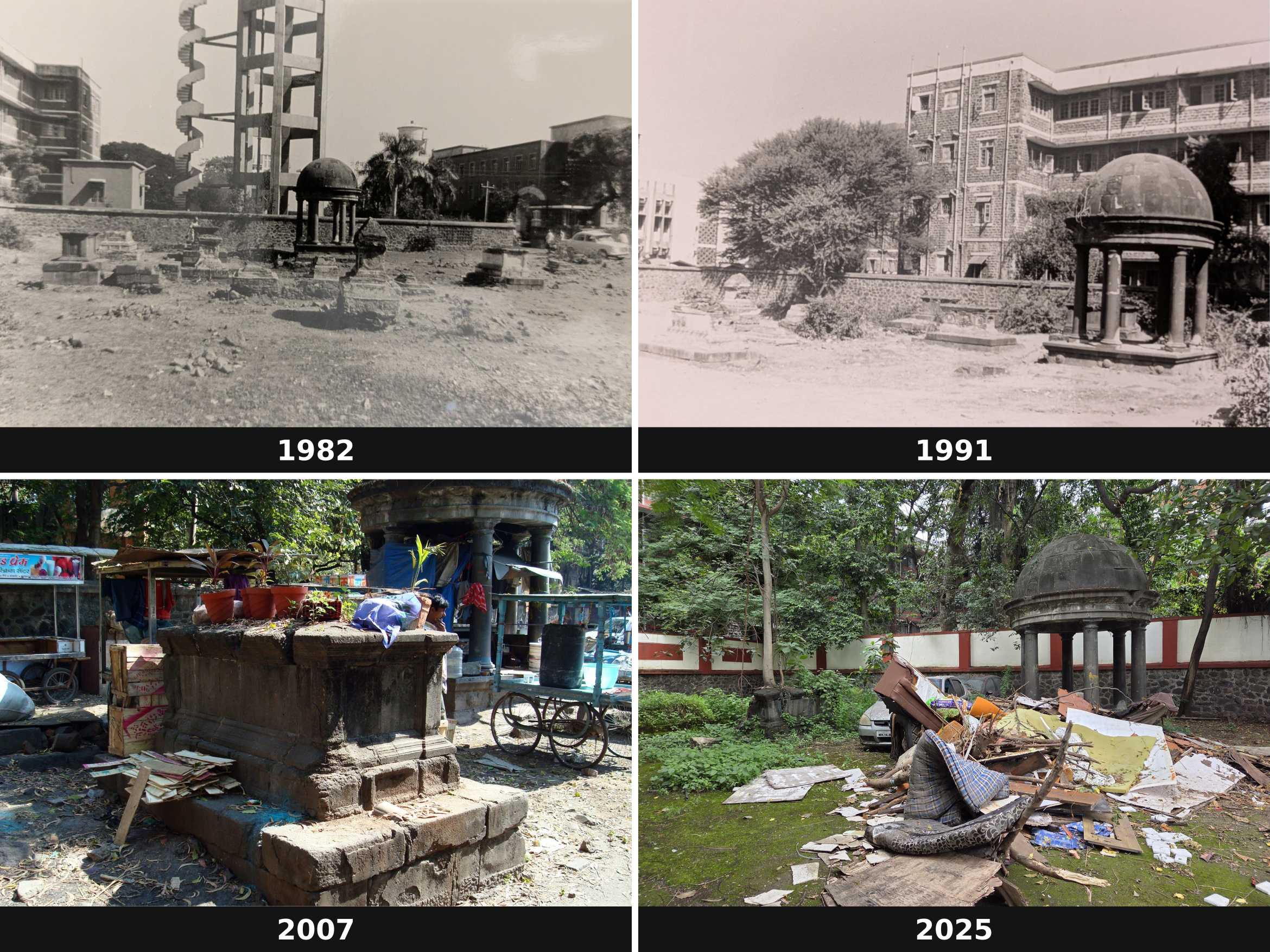
If you have taken the lane beside the State Bank of India branch off Church Road, behind the Collector's office in Pune Camp, you have passed it: a small walled enclosure, set back under old trees. Inside, a domed canopy on six stone pillars rises over a heap of dumped debris and a discarded mattress. Grey hatchback cars sit abandoned among the graves, and autorickshaws are parked tight against the box tombs by the wall, one of them a moss covered slab a tree has cracked open as it grew. Most people who pass have no idea it is a graveyard at all.
Nor can anyone say what it is. Search for it on Google Maps and you are told these are French tombs. For fifteen years the Pune press has been just as certain and just as wrong: German tombs in one report, French in another, an old Jewish cemetery in a third.[1,2,3,4] None of it is right. The people under this ground were British, officers and families of the East India Company who died in Poona in the years after it took the city from the Marathas.

Here is what it is. In 1909 the old European tombs of Poona were declared a Protected National Monument under the Ancient Monuments Preservation Act, the same legal status held by the Aga Khan Palace and Shaniwar Wada.[5] And here is what happened to it. When the Comptroller and Auditor General audited India's monuments, the Pune tombs turned up on the list of those the country had lost. Untraceable. Missing.[6,7]
It was never missing. It has stood in plain sight the whole time, behind a government office, in the middle of Pune. That alone should have been enough to look after it.
What the plot is used for now is easier to answer. The Collector's office has designated it one of the city's protest grounds. On the days a crowd gathers, the placards go up over the graves. There is an irony in that which nobody involved could have known: the land was never the Collector's to give. It is a Protected National Monument and has been for over a century.
The Archaeological Survey of India could not claim it either. The ASI knew there was an old cemetery here. What nobody had was a document tying this particular ground to the "Old European Tombs" on the list of monuments the government had lost. Without that link, the protection sat on a name with no address attached.
That document exists. It has been sitting in print since 1897, and I found it while chasing this cemetery's larger, vanished cousin, the East Street Cemetery, now buried under Fashion Street. This is what it says, and this is who it turns out to be protecting.
What It Was
Start with what to call it. Every name this ground carries is borrowed. Burials ended around 1822 and St. Paul's Church was not built until some fifty years later, so nobody buried here ever heard the name the place now goes by. Garpir, the name the older records use, belongs to the Muslim shrine next door, the grave of a saint remembered as the Gar Pir, the stone saint, from gar, stone, and pir, saint. The whole quarter took its name from him.
Garpir was a British military camp, not a graveyard. General Wellesley made it the cantonment for the force guarding Poona in 1803, and it stayed the camp until the final break with Baji Rao Peshwa in 1817. The graves came after. The earliest legible inscription is dated 1819 and the latest 1822, the years immediately following the Company's defeat of the last Peshwa in 1818. Having taken the city, the British turned their disused cantonment ground into a place to bury their dead.[8]
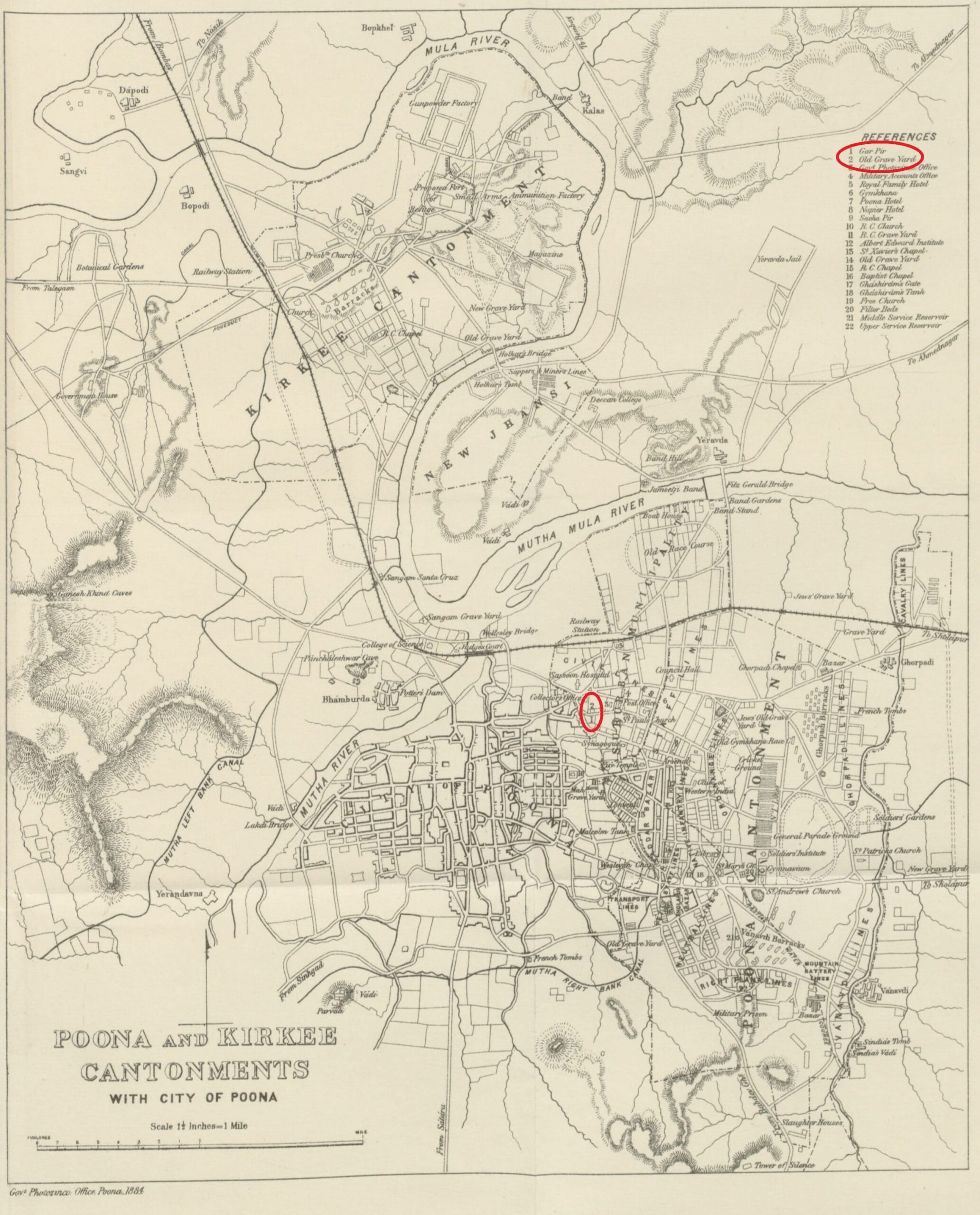
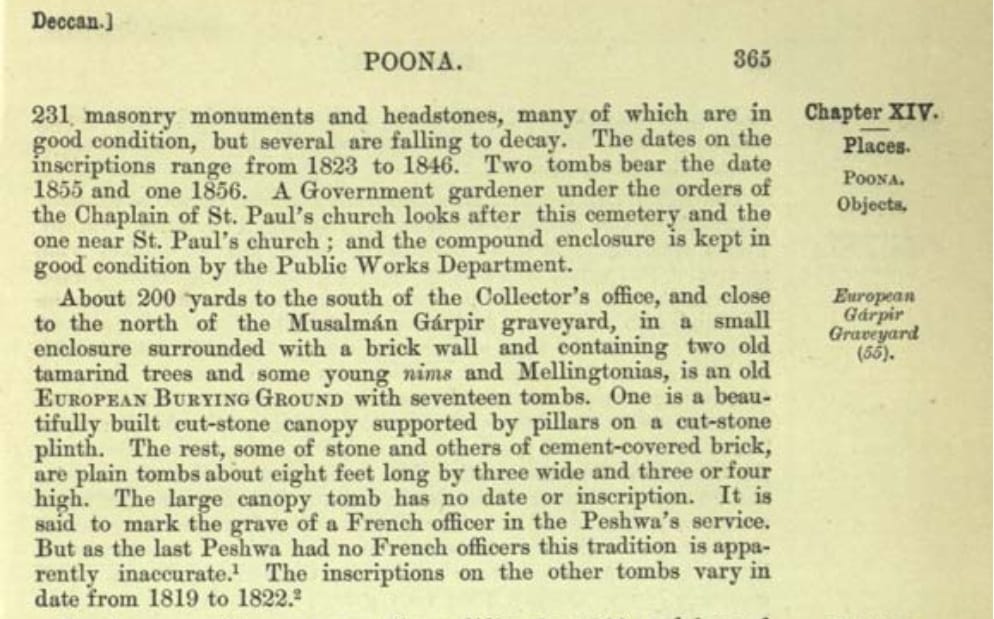
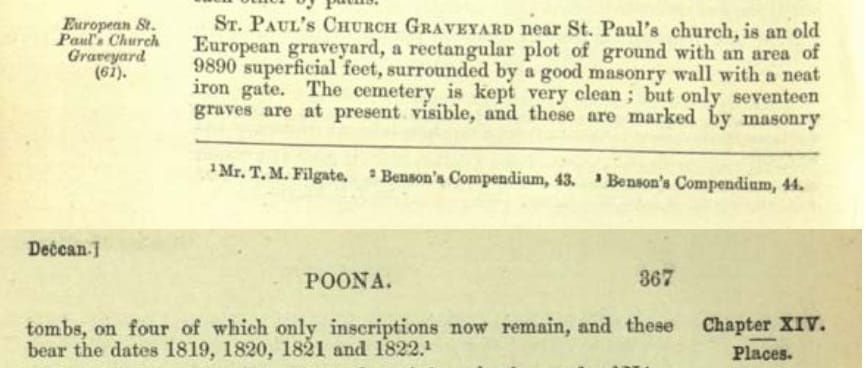
It was never large. The Gazetteer of 1885 describes it twice, a few pages apart and under two different names, and between the two entries you get the whole place: a rectangle of 9,890 square feet behind a masonry wall and a neat iron gate, holding seventeen graves, four of them still carrying inscriptions dated 1819, 1820, 1821 and 1822. One tomb is singled out, a cut-stone canopy on pillars.[8]
Around 1819, as Mountstuart Elphinstone, Commissioner of the Deccan and the man after whom Elphinstone College is named, prepared to leave Poona, he enclosed this small graveyard with the wall we still see and ordered a larger burial ground opened.[9] That wall has very likely helped it survive.
The Dome Nobody Could Name
Your eye goes straight to it. Every other grave here is a plain box tomb. This one is a monument: a cut-stone dome resting on six pillars, raised on a platform. And it carries no name, no date, no inscription of any kind.
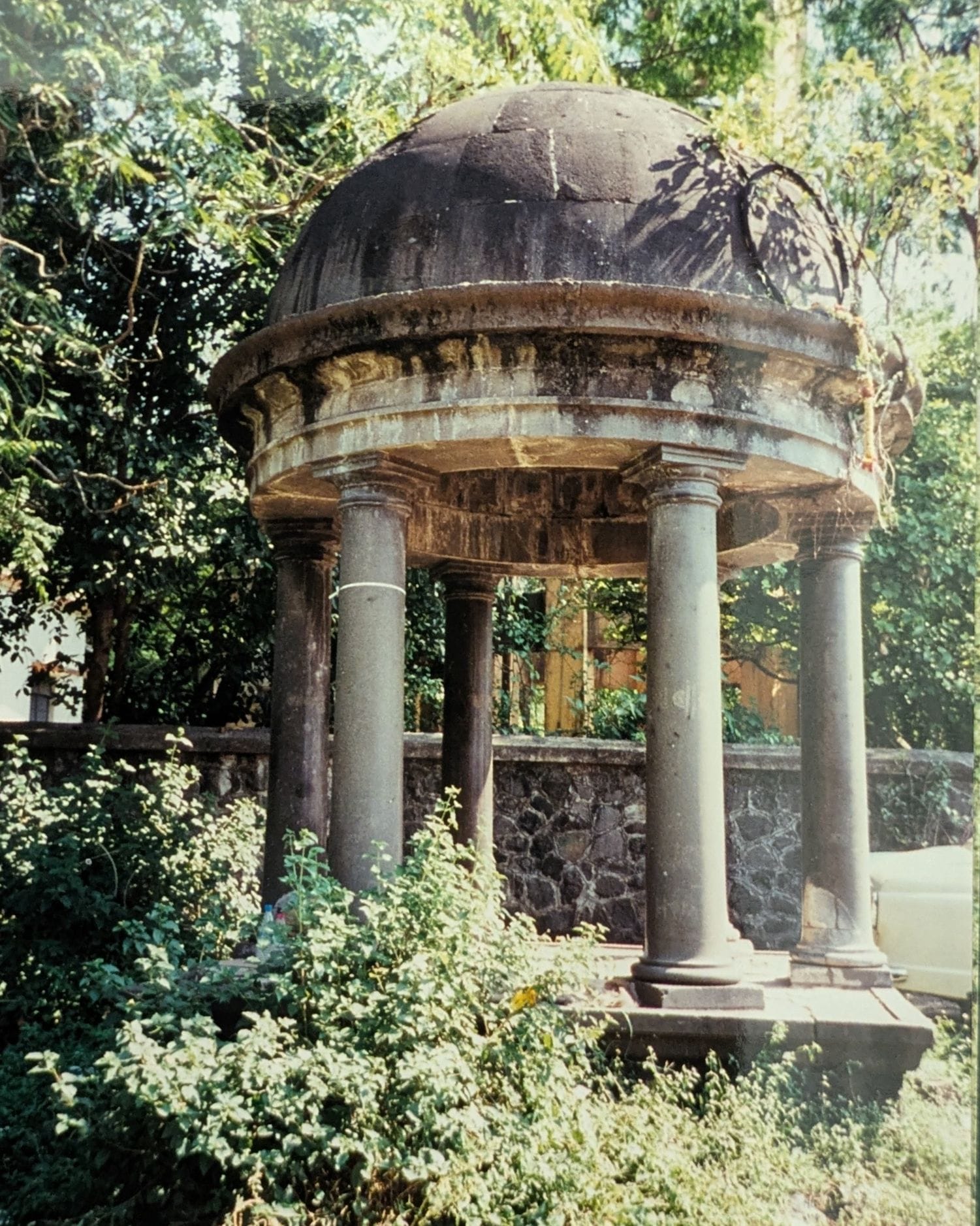
For more than 150 years people have guessed. An 1863 account of strolls around Poona gives it to a Mrs Virges, wife of the Deputy Paymaster of the Poona Division, whose husband built the canopy, left for Calcutta to fetch a statue to stand beneath it, and never came back.[9] The rival story, repeated ever since, is that the dome covers a French officer of the Peshwa's army, or his wife, a Madame Dudrenec. The Gazetteer disposed of that one in 1885: the last Peshwa had no French officers at all, and Poona's actual French graves lie elsewhere, at Ghorpadi and on the old Parvati Hill road, today's Shankarsheth Road.
So the grandest thing in the cemetery is the one thing nobody can put a name to. Seventeen people were buried here. Walk in today and you will find barely half. Not one name is still legible on the stone. Everything we now know about these people has come off paper rather than stone: old gazetteers and monumental inscription rolls, a newspaper column from 1860, and death records and copies of their wills held in the India Office Records at the British Library. A column in that 1860 newspaper is the last record of anyone standing here and reading the graves aloud. It lists six names.[10]
Five of them we can follow.
Who Were Buried Here?
Joseph Cunningham · 1816–1821 · aged four
Killed by a weapon India invented firstHere lies a four year old boy, killed by a rocket.
Joseph Cunningham died in Poona on Saturday, 24 February 1821, aged four years and six months. His father, also Joseph, was a Corporal in the Bombay Foot Artillery, the East India Company's gunners. The child was killed by the accidental discharge of a rocket, the very weapon his father's corps handled, and his grieving parents raised this stone over him.[11]
There is a bitter circle in how he died. The British had learnt to build these rockets only after facing the iron-cased rockets of Tipu Sultan and Hyder Ali of Mysore. A design India perfected first, copied by the empire that defeated it, ended the life of a small boy in the heart of the conquered Deccan.
Henry Forbes Shubrick · 1821–1822 · aged eleven months
An infant whose surname is on four American warshipsHenry Forbes Shubrick was born in Pune in late 1821, one of a pair of twins, and died here on 15 October 1822. His father, Charles Robert Shubrick, was Collector of Broach, today's Bharuch in Gujarat, and died in March 1822, months before his infant son.
The name reached a great deal further than this walled plot. The same rare family produced a celebrated line of United States Navy officers, and four American warships have carried the name USS Shubrick. The eleven month old under this ground is the reason it appears in Pune at all.
Elizabeth Mayne · 1819–1821 · aged nineteen months
A silver cup from Elphinstone could not buy a second monsoonElizabeth Mayne was buried here on 22 April 1821, aged nineteen months. Her father, Major John Mayne, was a Deputy Quarter-Master General of the Bombay Army. Her mother was Mary Ann, and it is on her side that the story opens out.
Her brother, Captain Thomas D'Arcy Morris, was a cavalry officer and a celebrated sportsman. At the Poonah Races of 1819 he won a silver gilt cup made by Paul Storr, the finest London silversmith of the age, presented by Mountstuart Elphinstone himself. Morris gave it to his sister. The cup still exists.[12]
So in 1819 this family stood at the very summit of the new British Poona. Two years later, in the same small camp, none of that standing could keep a child alive past her second monsoon. The British had a grim saying for it: a life in India lasted two monsoons. Elizabeth's barely lasted that. The cup passed down the family for generations, handed from one heir to the next. The daughter stayed here, under a stone whose lettering has long since worn away.
Captain Samuel Hallifax · d. 1820 · Bombay European Regiment
A poor man's son whose Pune fortune bought an English parishCaptain Samuel Hallifax died in Pune on 26 January 1820, in his early thirties. The son of a village schoolmaster, with no money or name behind him, he joined the East India Company's army, sailed to India, and rose quickly to a senior staff post in the Poona Division.
And like many British officers, he grew rich here. Part of it was prize money, the reward handed to soldiers after a war, taken straight from the land they had just conquered: in his case the Deccan around Pune itself. His estate ran to over ₹46,000.[13]
None of it stayed in India. It sailed home to his mother, and then to his brother Joseph, a priest. In 1835 Joseph spent £2,700 of it buying the right to appoint the priest of Kirkbride church in Cumberland, and appointed himself.[14]
Measured in gold, the steadiest yardstick across two centuries, Hallifax's estate of about ₹46,000 was close to 30 kilograms, roughly ₹37 crore today. The £2,700 his brother spent was close to 20 kilograms, about ₹24 crore: well over half of everything the soldier had sent home, spent on a single English parish.
Captain John Lewis · d. 1819 · Poona Auxiliary Horse
His regiment still fights for India, and the dome may be hisCaptain John Lewis, buried here in 1819, was among the earliest officers of the Poona Auxiliary Horse, a cavalry regiment raised in 1817 under the treaty that stripped Peshwa Baji Rao II of his own cavalry. Nineteen months before Lewis died, that regiment stood with the small Company force at Koregaon Bhima, a few hundred soldiers who held off a far larger Peshwa army. Many who fought there were Mahars, and the battle is honoured still: every 1 January, lakhs gather at the victory pillar, a day remembered as Shaurya Diwas.
The regiment never stopped. It became the Poona Horse, today the 17 Horse, an armoured regiment of the Indian Army and holder of two Param Vir Chakras, one from 1965 and one from 1971.[15]
On the morning he died, Captain Peter Lodwick witnessed his last papers at the bedside, the same man who in 1824 became the first European to climb the hills of Mahabaleshwar. Lodwick Point is named after him still.[16] Two men in the same room in Pune in 1819: one is now a viewpoint thousands photograph every year, the other a nameless stone under a discarded mattress.
Lewis also died a rich man, his estate running to the order of ₹50,000, more than 30 kilograms of gold and well over ₹37 crore today, almost all of it shipped home through the 1820s to his widow, Mrs Elizabeth Lewis, in England.[13]
Two graves in one small plot, and the same story repeated across an empire: a fortune made in India, often out of the spoils of a war fought on Indian soil, then shipped home to buy land and standing for families who never returned. History has always moved treasure from the defeated to the victor. But it is worth setting down plainly: a real part of what Britain built, it built with wealth that came from here.
And one thing more. His inscription records that his monument was raised "by his brother officers of the Poona Auxiliary Horse," the language of a memorial rather than a burial, and no other grave here answers that description. On the evidence the dome is more likely his than a paymaster's wife's, or a French officer who never existed. Nothing proves it.
How It Was Lost
A national monument does not disappear through malice. It disappears through the slow withdrawal of the attention that kept it alive, and in this case through one clerical decision taken in 1897.
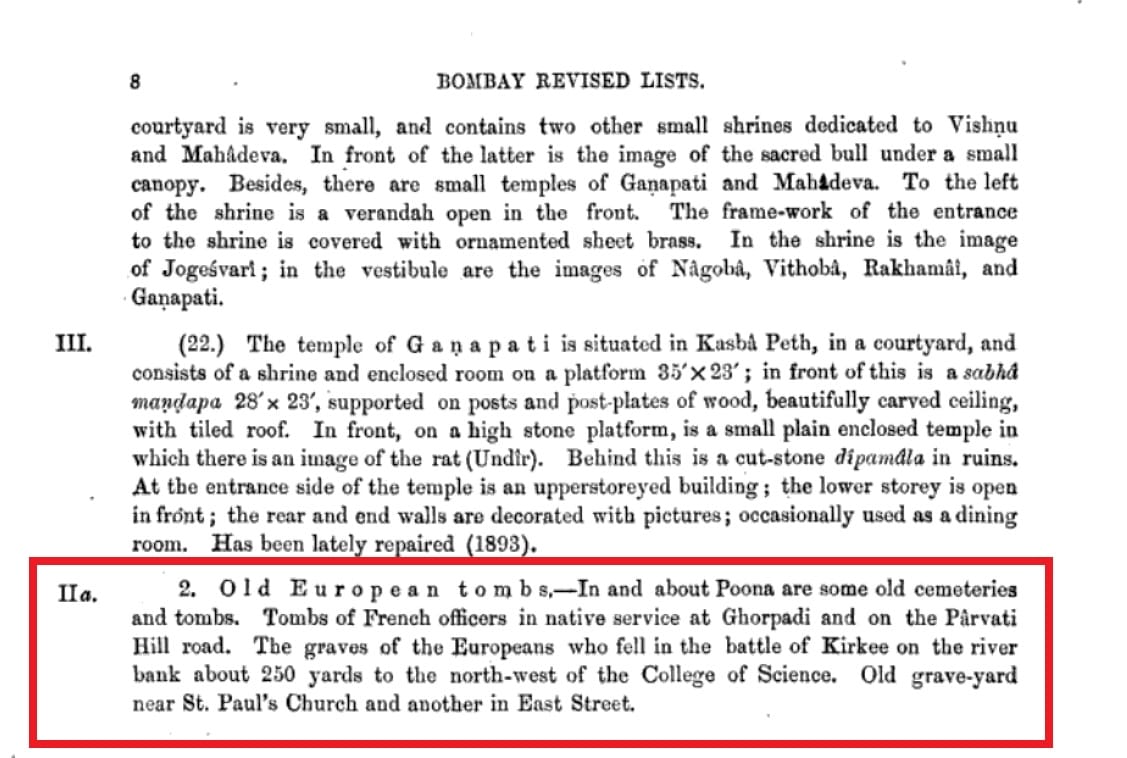
That year the Archaeological Survey recorded all five of Poona's European burial sites under a single heading: "Old European Tombs."[5] In 1909 that one entry became a Protected National Monument. But five separate grounds, scattered across the city, had been bundled into a single line, and not one of them was ever separately mapped. When the records thinned, the protection was left attached to a name with no address. That is why the Comptroller and Auditor General's auditors, looking for the Pune tombs, could not find them, and why the Pune Municipal Corporation's own heritage list names the "European Tombs" of the Camp to this day without anyone being able to say where they stand.[17]
On the ground, the forgetting took longer. For a while after Independence the system held: the graves passed to the care of the British High Commission, a local body called the Poona Cemetery Committee looked after them, and the Chaplain of Poona still made his rounds. Then money ran short and interest faded with the generation that remembered the names. The upkeep stopped. And the living community began to ask whether the land might not serve the Christians of Poona instead.
So it was wanted. Between roughly 1958 and 1967 three parties tried for this ground, and each was turned back by the same rule: the graves could not be disturbed. The Catholic Bishop of Poona wanted it for a chapel and houses for poor families. A newly formed Indian Christian society wanted a community hall. And the Dean of B.J. Medical College next door, which surrounds the plot on three sides, wanted hostel quarters.[18]
That last bid came to a head in March 1967, when the Maharashtra Government asked the Central Government to hand the plot to the College, describing a fully abandoned ground without a single marking stone on it. The Centre sent its own engineer to look. He found one dome in good condition and twelve graves.
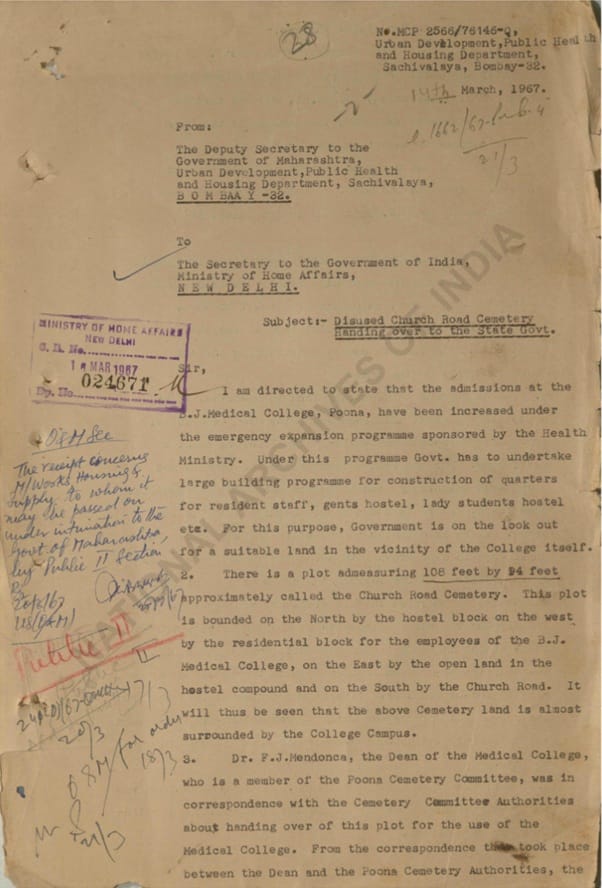
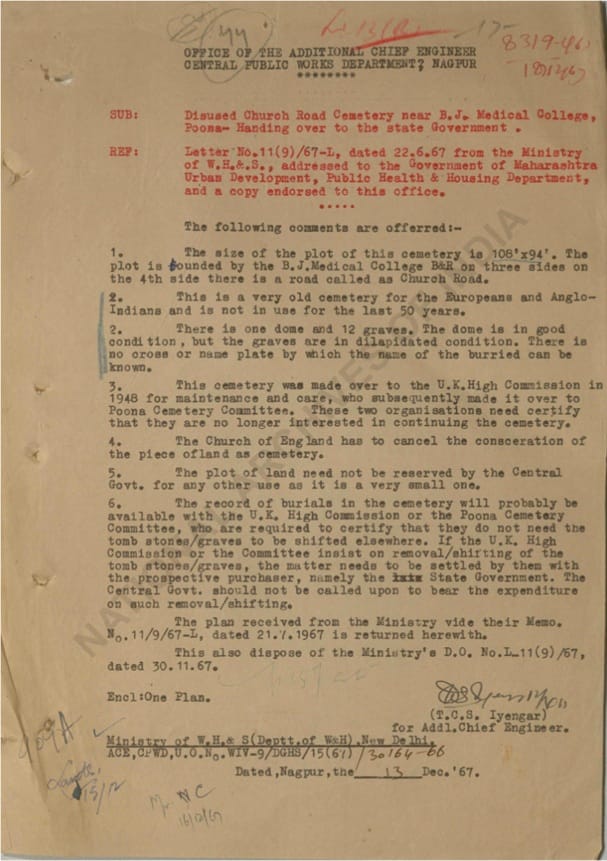
The correspondence went back and forth for years. To the government it was simply "the disused Church Road Cemetery." Nowhere in it does anyone note that the ground had been a Protected National Monument since 1909, and the blindness ran through both governments, not one: for a decade the Indian and British authorities wrote to each other about what to do with this plot, and both sides kept a file on it.[18] In neither file does the word "monument" appear.
In March 1972 the Central Government refused, for one reason only. In 1949 India had promised the United Kingdom that these cemeteries would be safeguarded from destruction and desecration like any government property. A diplomatic assurance given a generation earlier, and forgotten by everyone since, is why there is anything here to see at all.[19]
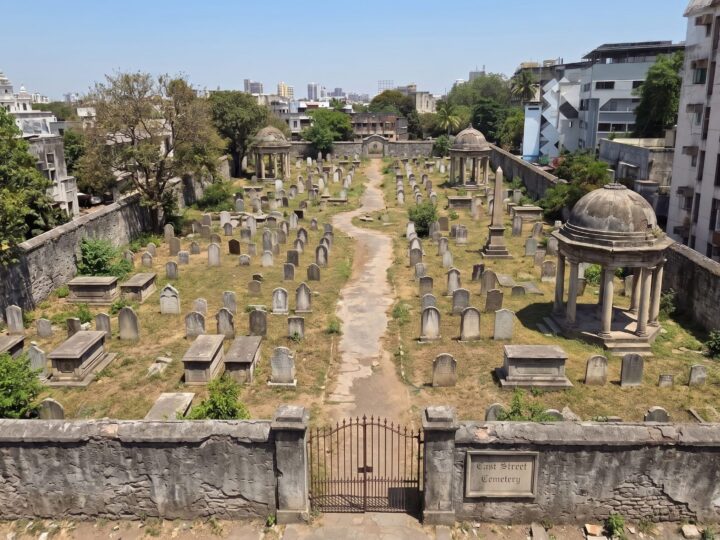
Not every site was so lucky. One set of these tombs, near the College of Engineering by the Mula river, where the dead of the Battle of Kirkee were buried, is gone. Residents recall the graves razed in a single night to clear the plot for building. Around a hundred tombs.[20]

Here, the wall held and the dome held. The names went. Some weathered away, but many did not go so gently: by 1860 a visitor already found the tombs "robbed of their iron railings and slabs."[10] Over the last century the plot has been eyed for building land, used as a parking lot, a dump, a hawkers' spot, and finally a protest ground outside the Collector's office.[4]
July 2026: Walking the Ground with the ASI
The 1897 list is the one edition in which the Old European Tombs are not merely named but described: five sites, each located, including an "old grave-yard near St. Paul's Church." That description appears nowhere else. It is the single document tying this ground to the entry on the missing list.
In June 2026 I took it to the officials at the Archaeological Survey of India's Pune office. They heard the whole thing out and told me to put it in writing so the ASI could act on it formally. So I did. They were glad of it, and they had something to show me in return: the property card for the plot, CTS 8/1 on Church Road, an area of 928.9 square metres, its use recorded in the municipal record as Burial Ground (Cemetery). Nearly the same measurement the Gazetteer had set down in 1885.
In July a team from Mumbai came to Pune and walked all five locations in a single search. Three are gone. The Kirkee battle graves by the river, the tombs on the old Parvati Hill road, now Shankarsheth Road, and the East Street ground under Fashion Street have all been destroyed or built over, and nothing survives on them to protect. Two are still standing: the French burial ground at Ghorpadi, and this one, behind the Collector's office, where the dome has stood the whole time. At this site the team counted eight tombs.
The visit came at a fortunate moment. The Collector's office had been preparing to put up a toilet block on the burial ground, and the ASI stopped the work. A monument protected by law since 1909 was days away from being built over, because for a century nobody could say where it was.
The rest follows. The ASI had earlier asked for these sites to be de-notified altogether, since nobody could find them; that request is now being revisited. Both surviving European Tomb sites are to be cleaned up and given signboards setting out what the ground is and whose graves lie in it, so that anyone walking past can read its history instead of guessing at it. A monument the government had written off as untraceable has been found.
One thing only, then, when the boards go up: let them carry the names. The captain whose fellow officers built him a monument. The corporal's small son killed by a rocket. The girl of nineteen months whose family had been handed a silver cup at the races two years before. A board with names on it is far harder to walk past than a board with a category.
And there is more we cannot reach. Much of this cemetery's story survives only in old government files, faded newspaper columns, and the memories of older Punekars who walked past this dome when its tombs still stood. If you know something about this place, or remember it from years ago, please leave a comment below. The boards are being planned now, and what we establish here may end up on them.
Three of the five sites are already gone, and nobody noticed them going. We restore forts and we photograph palaces, but a graveyard is the one kind of monument that asks nothing of us and offers nothing back, and so it is the first thing a city puts down and forgets it was holding. This one survived by accident: a wall an Englishman built in 1819, and a promise made in 1949 that everybody forgot. It deserved better than luck, and so do the eight tombs still standing there this morning.
If this made you look differently at a stretch of Pune you thought you knew, share with others who may also appreciate it.
KEY FACTS
- Site
- St. Paul's Church Road Cemetery, Pune. Also recorded as the European Garpir Graveyard, the European St. Paul's Church Graveyard, and the Disused Church Road Cemetery.
- Location
- A walled plot of about 9,890 square feet off Church Road, behind the District Collector's office, Pune Camp, Maharashtra. Approximately 18.522173°N, 73.872103°E.
- Dates of burial
- Earliest legible inscription 1819, latest 1822.
- Status
- Part of the "Old European Tombs" of Poona, declared a Protected National Monument in 1909, later listed among the ASI's untraceable monuments, and physically located and confirmed by an Archaeological Survey of India team in July 2026.
- What survives
- One domed canopy on six stone pillars, and eight tombs of the seventeen recorded in 1885.
- Named burials
- Captain John Lewis (1819), Captain Samuel Hallifax (1820), Captain John Shirreff (1820), Joseph Cunningham (1821), Elizabeth Mayne (1821), Henry Forbes Shubrick (1822).
TIMELINE
- 1803 General Wellesley makes Garpir the cantonment for the British force guarding Poona
- 1819–22 The dated burials; every legible inscription belongs to these four years
- 1885 The Gazetteer records seventeen graves, four still inscribed
- 1897 The Archaeological Survey of India records five Poona burial sites under one heading, "Old European Tombs"
- 1909 That entry is declared a Protected National Monument
- 1949 India assures the United Kingdom that these cemeteries will be safeguarded
- 1967 The Centre's engineer records one dome and twelve graves
- 1972 The Central Government refuses the handover, citing the 1949 assurance
- 2013 The Comptroller and Auditor General lists the Pune tombs among the country's missing monuments
- 2015 The plot is designated a protest ground
- July 2026 An ASI team walks all five sites; eight tombs counted here, and the toilet block stopped
Bibliography
- European Tombs in Pune Lie Forgotten by DNA (2011). dnaindia.com ↑
- Tombs of French Soldiers in City Crying for ASI Attention by Indian Express (2016). indianexpress.com ↑
- Generous Jews Built Pune's Edifices, but Graves of Community Members Lie in Ruin by Times of India (2017). timesofindia.com ↑
- District Collectorate Takes Note of Long Forgotten German Tombs by Indian Express (2017). indianexpress.com. Also ASI Looks for Missing Old European Tombs by Times of India (2013). timesofindia.com ↑
- Revised Lists of Antiquarian Remains in the Bombay Presidency by Archaeological Survey of India (1897). ↑
- Report No. 18 of 2013 by Comptroller and Auditor General of India. cag.gov.in. Also 324th Report by Rajya Sabha Standing Committee (2022). rajyasabha.nic.in ↑
- European Tombs in City Are Untraceable: ASI Survey by Times of India (2018). timesofindia.com ↑
- Gazetteer of the Bombay Presidency, Vol. XVIII, Poona by Government of Bombay (1885). ↑
- Bombay Miscellany, Vol. VII by Chesson & Woodhall (1863 to 1864). ↑
- Poona Observer, reprinted in Allen's Indian Mail, 21 November 1860. ↑
- Monumental Inscriptions: Poona, Old Garpir Cantonment Cemetery by H. Bullock (1931). ↑
- A silver-gilt cup by Paul Storr, the Poonah Races 1819, Christie's. christies.com ↑
- British India Office Wills & Probate Records at the British Library. ↑
- Kirkbride Church in Transactions of the Cumberland & Westmorland Antiquarian & Archaeological Society, Vol. 15 (1896). ↑
- 17 Horse (Poona Horse) regimental history, Indian Army. ↑
- Gazetteer of the Bombay Presidency, Satara by Government of Bombay. ↑
- Grade Lists of Heritage Structures by Pune Municipal Corporation. pmc.gov.in ↑
- Maintenance of Cemeteries under the Poona Cemetery Committee (IOR/R/4/252 and IOR/R/4/253), India Office Records at the British Library. ↑
- Disused Church Road Cemetery: Handing Over to the State Govt. by National Archives of India (1967). ↑
- Mystery of Missing Monuments by Pune Mirror (2021). punemirror.com ↑
Acknowledgements
I am grateful to Dr. Wayne Mullen, author of Deccan Queen: A Spatial Analysis of Poona, for generously sharing his research and data for this article, and to Mr. Sanjay Deshpande for his guidance and support. My thanks also to Karen de Bruyne, for her help retrieving documents from the India Office Records at the British Library, and to Mr. Gajanan Mandaware, Senior Conservation Assistant at the Archaeological Survey of India, who heard out a stranger's research and acted on it.
Inscriptions: St. Paul's Church Road Cemetery, Poona
The legible inscriptions recorded at the Church Road Cemetery, drawn from the 1860 Poona Observer and Colonel H. Bullock's 1931 catalogue. The remaining tombs of the seventeen have lost their inscriptions entirely.
Full list of known inscriptions (click to expand)
Son of Charles Robert Shubrick, Collector of Broach (Bharuch). The family shared its name with the US Navy Shubricks and four USS Shubrick warships.
An early officer of the regiment that became the Poona Horse (17 Horse), Indian Army. His will was witnessed at his death by Captain Peter Lodwick, later the discoverer of Mahabaleshwar.
His father was a corporal in the Bombay Foot Artillery. The rocket that killed him was of a type the British developed after facing the rockets of Tipu Sultan and Hyder Ali of Mysore.
Son of the long serving headmaster of Wigton Grammar School, Cumberland. His Indian estate passed home to his family; his brother the Rev. Joseph Hallifax used it to buy the right to appoint the priest of Kirkbride church for £2,700 in 1835.
Recorded among the legible inscriptions in 1860. His story is yet to be traced.
Daughter of Major John Mayne of the Bombay Army. Her uncle won a Paul Storr cup at the 1819 Poonah Races, presented by Elphinstone. See her story above.
The documents, transcribed
Full text of the records reproduced as images above.
"About 200 yards to the south of the Collector's office, and close to the north of the Musalmán Gárpir graveyard, in a small enclosure surrounded with a brick wall and containing two old tamarind trees and some young nims and Mellingtonias, is an old European Burying Ground with seventeen tombs. One is a beautifully built cut-stone canopy supported by pillars on a cut-stone plinth. The rest, some of stone and others of cement-covered brick, are plain tombs about eight feet long by three wide and three or four high. The large canopy tomb has no date or inscription. It is said to mark the grave of a French officer in the Peshwa's service. But as the last Peshwa had no French officers this tradition is apparently inaccurate. The inscriptions on the other tombs vary in date from 1819 to 1822." Gazetteer of the Bombay Presidency, Vol. XVIII, Poona (1885), entry 55
"St. Paul's Church Graveyard near St. Paul's church, is an old European graveyard, a rectangular plot of ground with an area of 9890 superficial feet, surrounded by a good masonry wall with a neat iron gate. The cemetery is kept very clean; but only seventeen graves are at present visible, and these are marked by masonry tombs, on four of which only inscriptions now remain, and these bear the dates 1819, 1820, 1821 and 1822." Gazetteer of the Bombay Presidency, Vol. XVIII, Poona (1885), entry 61
"IIa. 2. Old European tombs. In and about Poona are some old cemeteries and tombs. Tombs of French officers in native service at Ghorpadi and on the Pârvati Hill road. The graves of the Europeans who fell in the battle of Kirkee on the river bank about 250 yards to the north-west of the College of Science. Old grave-yard near St. Paul's Church and another in East Street." Revised Lists of Antiquarian Remains in the Bombay Presidency, Archaeological Survey of India (1897)
"There is a plot admeasuring 108 feet by 94 feet approximately called the Church Road Cemetery. This plot is bounded on the North by the hostel block on the west by the residential block for the employees of the B.J. Medical College, on the East by the open land in the hostel compound and on the South by the Church Road." The same letter records that the land "was being used as a burial ground for Europeans and Anglo-Indian soldiers about 50 years back," that "there is not a single marking stone in its place," and that "there are also no records available as to who is buried where." Maharashtra Government to the Central Government, 14 March 1967, National Archives of India
"The size of the plot of this cemetery is 108' x 94'. The plot is bounded by the B.J. Medical College B&R on three sides on the 4th side there is a road called as Church Road. This is a very old cemetery for the Europeans and Anglo-Indians and is not in use for the last 50 years. There is one dome and 12 graves. The dome is in good condition, but the graves are in dilapidated condition. There is no cross or name plate by which the name of the burried can be known." CPWD engineer's inspection note, December 1967, National Archives of India

Related Articles
6 Comments
-
Fantastic detective work, Rahul!
-
Admirable research work! Thank you.
-
Awesome piece of Indian & British history
-
Awesome piece of Indian and British history
-
AWESOME PIECE OF INDIAN & BRITISH HISTORY
-
Excellent research and article Rahul. You are truly a great restorer to life of these long forgotten cemeteries. Keep up the good work.


