
You've Been Shopping on a Graveyard
Beneath Pune's Fashion Street lie 231 graves, a lost national monument, and a secret that slipped through the city's memory without anyone noticing.
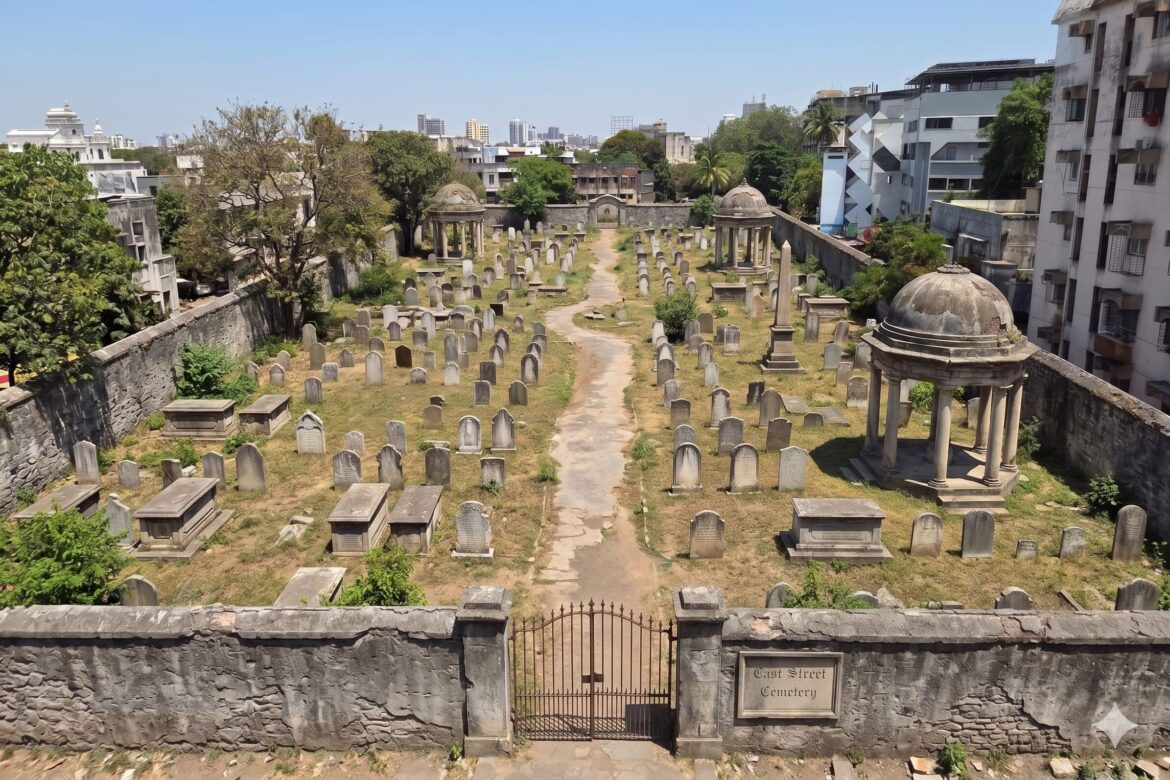
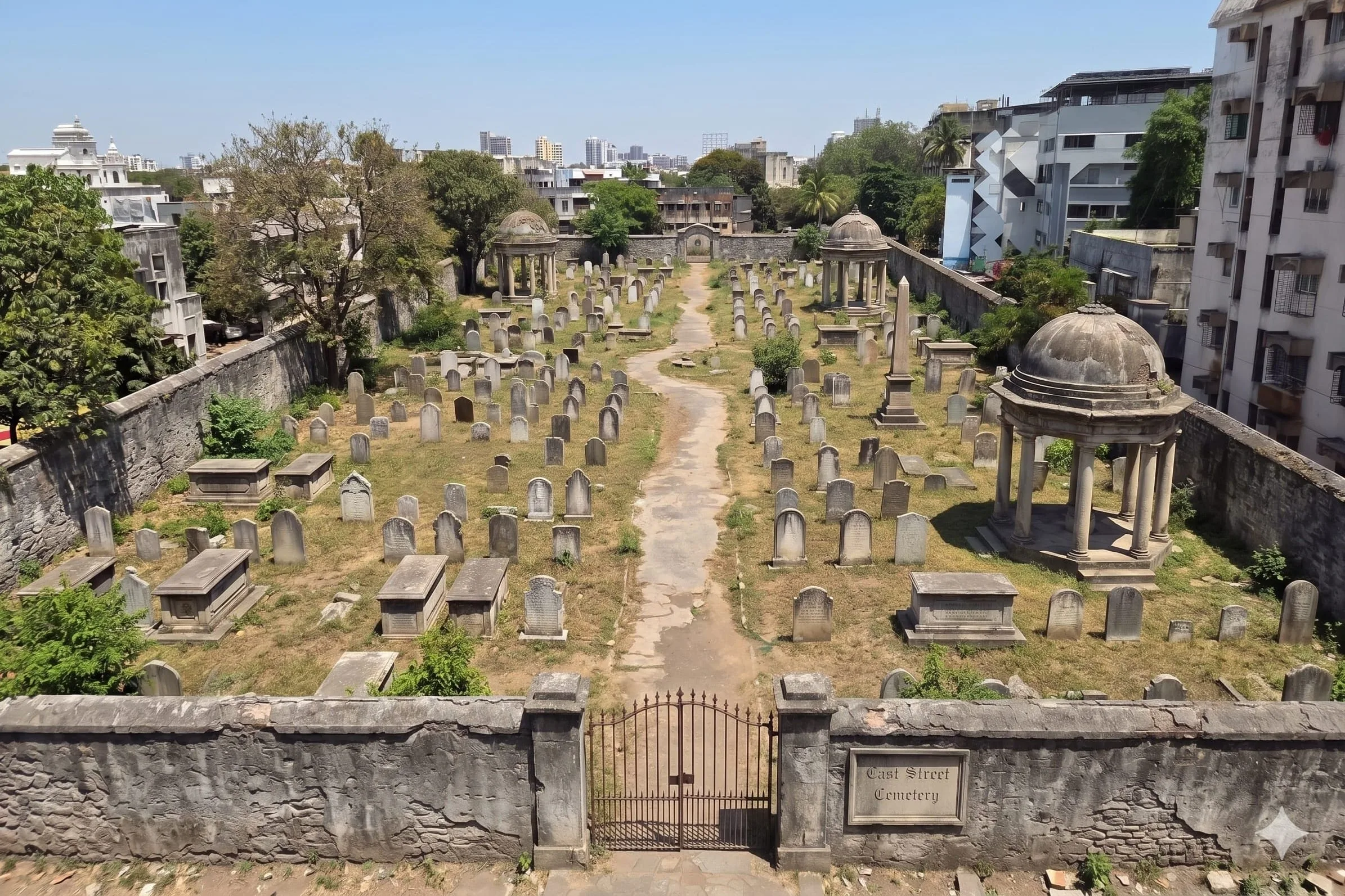
The East Street Cemetery in Pune Camp is a Protected National Monument — declared by the Archaeological Survey of India (ASI) in 1909, giving it the same legal status as Ajanta, Ellora, and the Taj Mahal. In 2006, the ASI admitted to Parliament that 35 protected monuments across India were untraceable. The East Street Cemetery was among them.[1] As of March 2024, it remains one of just 24 monuments in India that are completely untraced.[2] They never found it. This blog will show you exactly where it is.
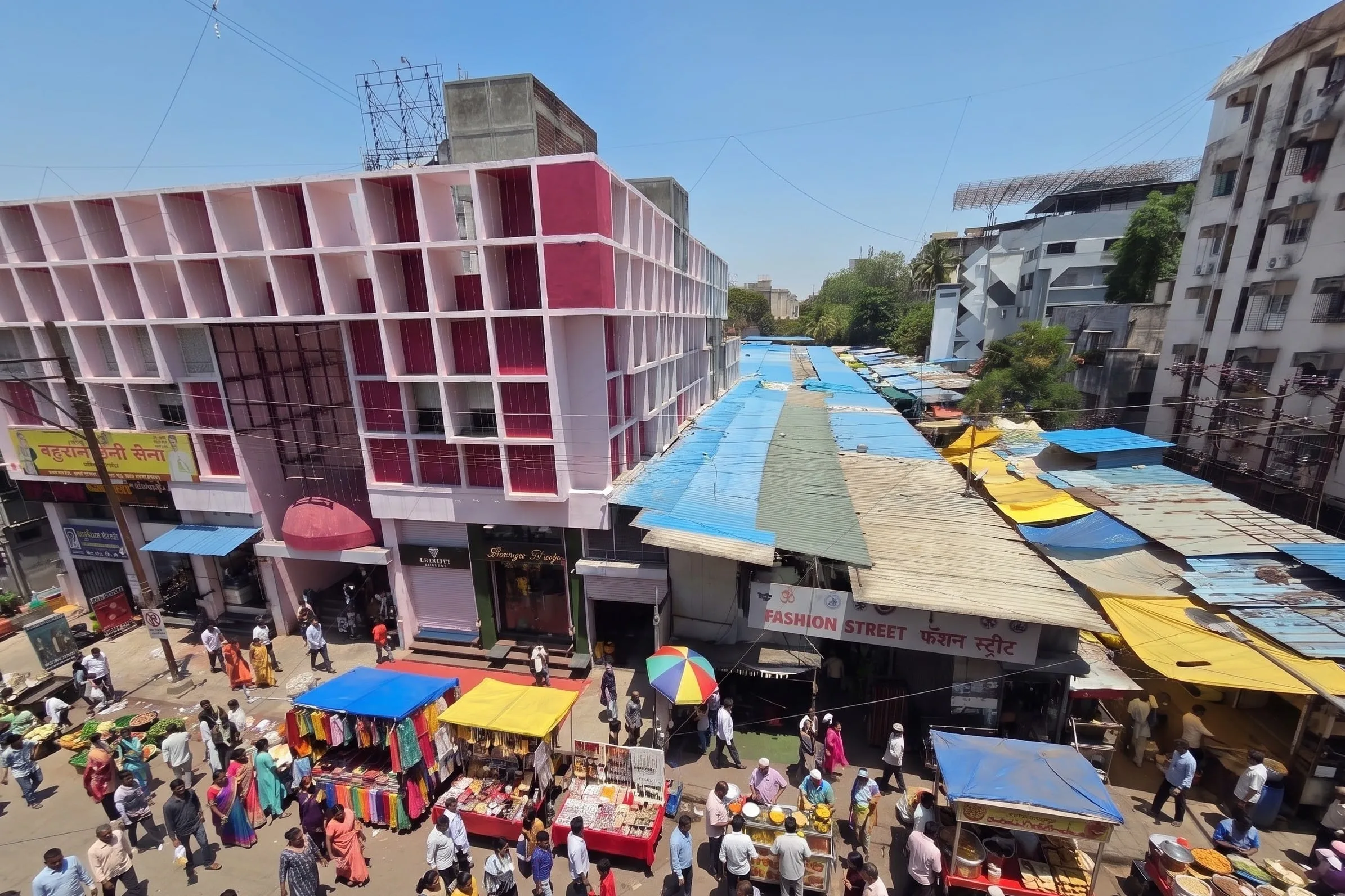
You've almost certainly been to Fashion Street — the hawkers' market on East Street, Pune Camp, just off M.G. Road. Most Punekars have. You've haggled there, stood in the narrow alley between two rows of stalls, picked up a t-shirt, put it back, picked it up again. It's loud and familiar and slightly chaotic, the way Pune's best places tend to be.
What you probably don't know — what I didn't know until recently — is what's underneath it.

The ground beneath Fashion Street at Pune Camp was one of the largest cemeteries in British Poona. Two hundred and thirty-one confirmed graves.[3] Poets, soldiers, infants, merchants — people who came to this city and never left it. And above all of them, for the past three decades, Punekars have been shopping for cheap clothes. The East Street Cemetery here is an ASI-protected monument — and it has been declared missing.
The Rabbit Hole
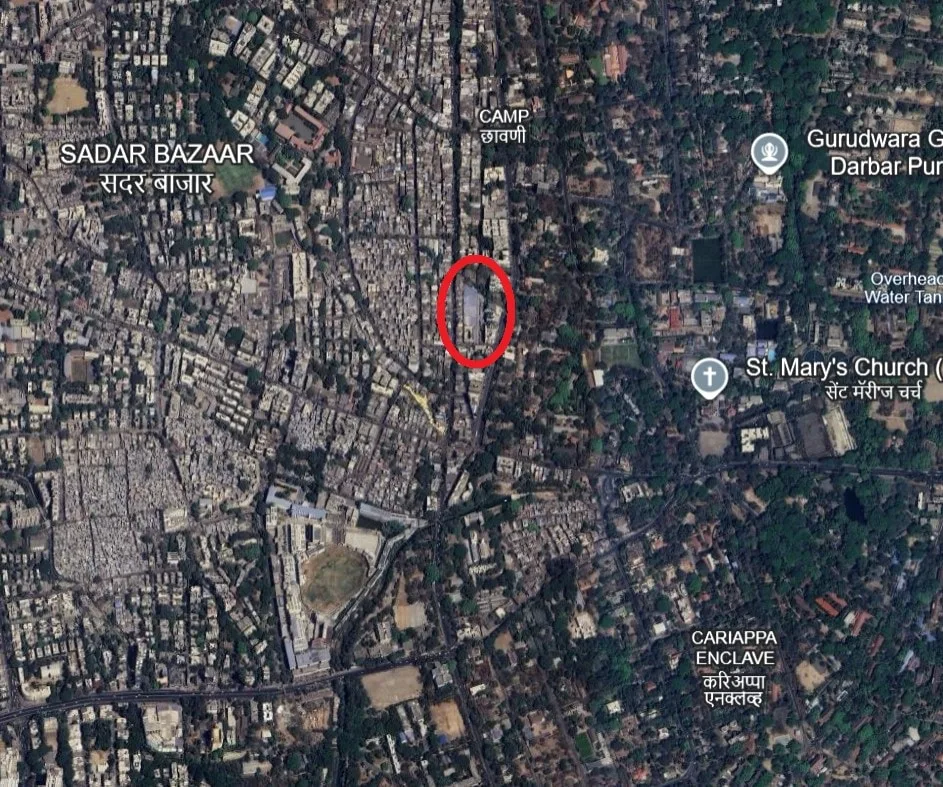
I stumbled onto this while reading an 1858 document about water supply to the Poona Cantonment. I grew up in the Cantonment — on M.G. Road, about five minutes from where Fashion Street now stands — and I have always been curious about the city's history. One document led to another, and I came across an old map.
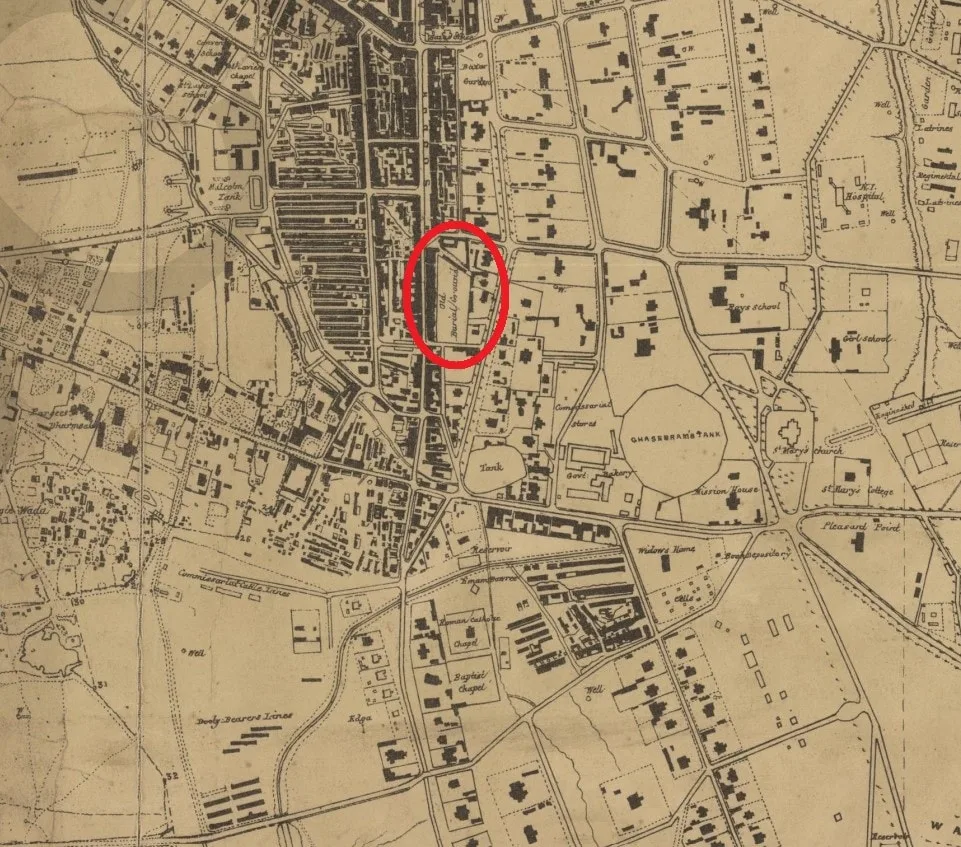
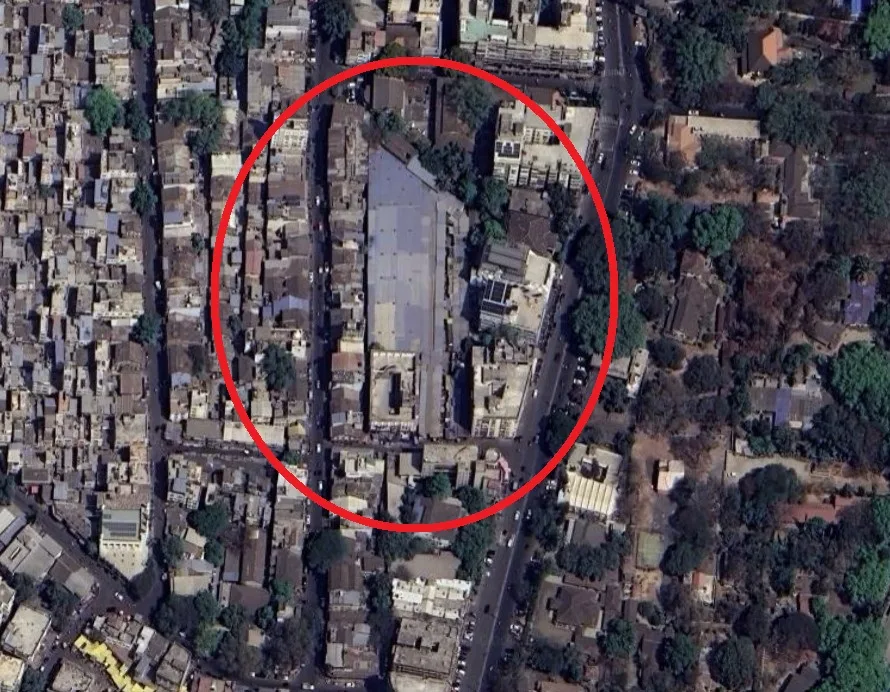
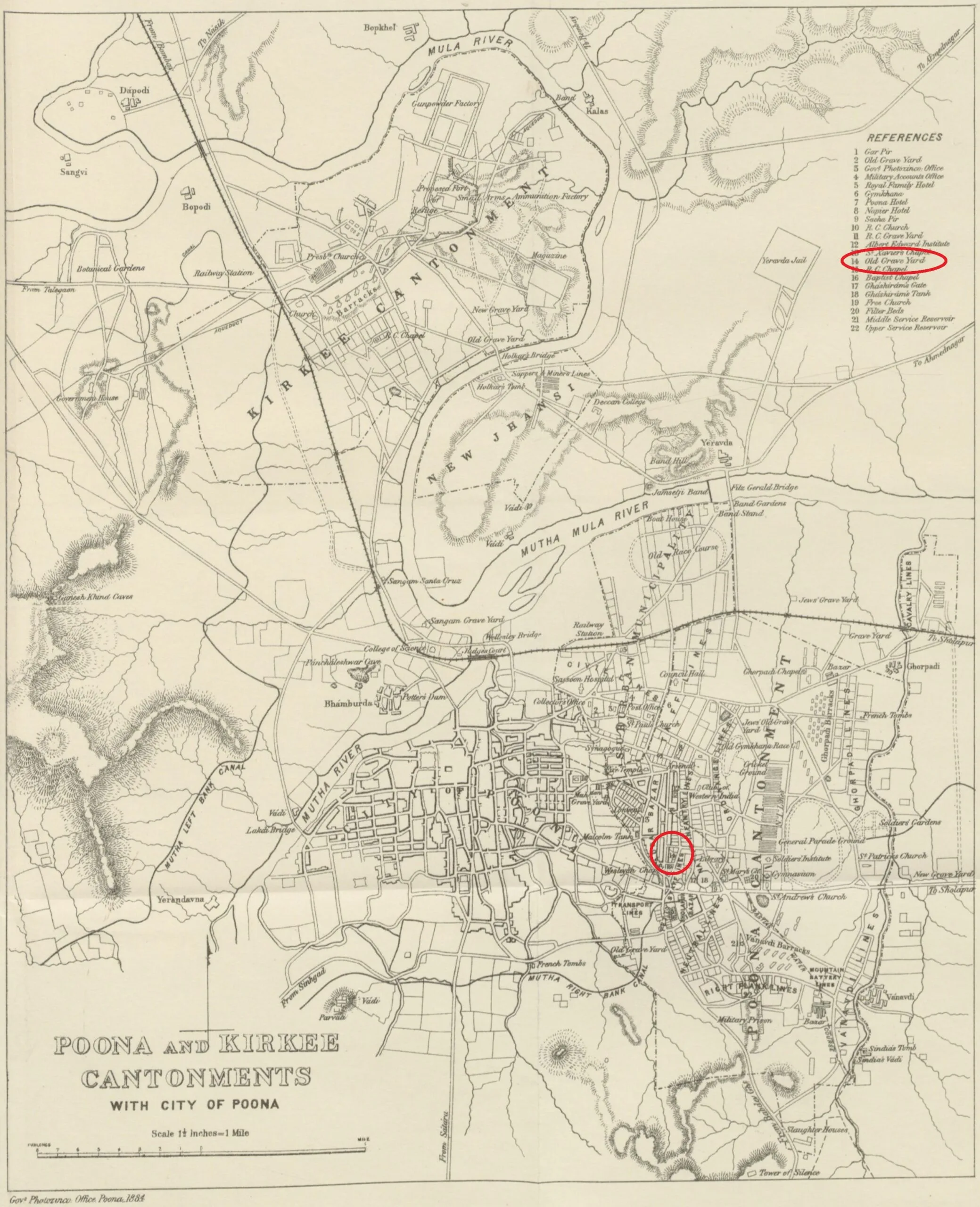
It was the 1879 Plan of the City and Cantonment of Poona. Right there, between Main Street — today's M.G. Road — and East Street, sat a large trapezium-shaped plot, clearly labelled: Old Burial Ground. An 1884 cantonment map confirmed it: same plot, same shape, now labelled Old Grave Yard.
My old house was practically around the corner from East Street. I had walked past this stretch hundreds of times. I had no idea.
What Was Here
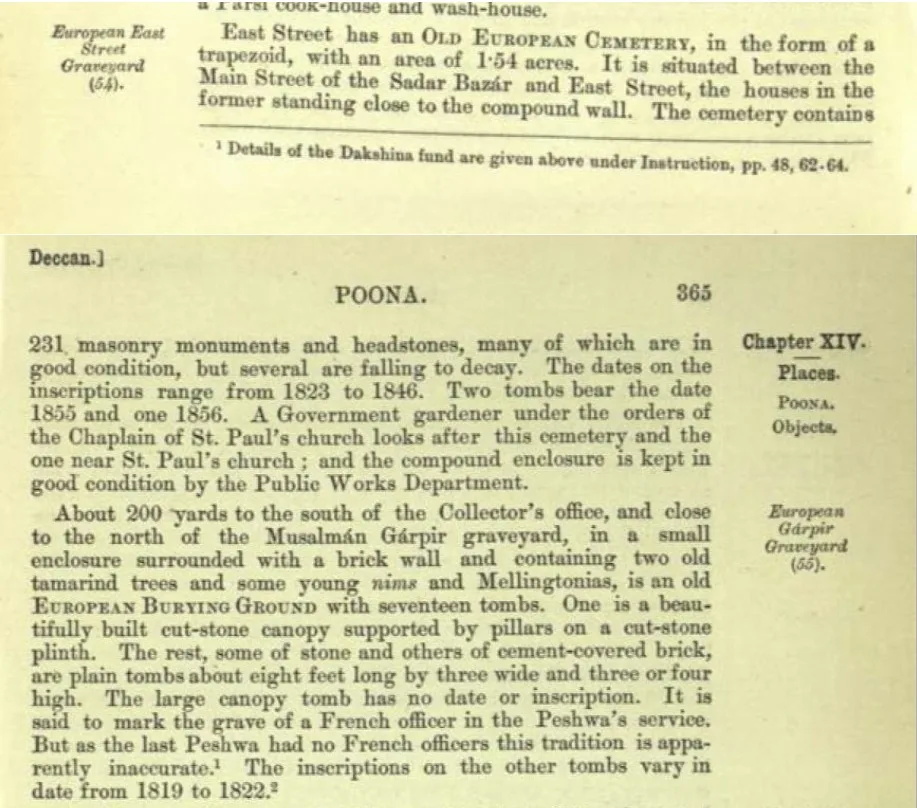
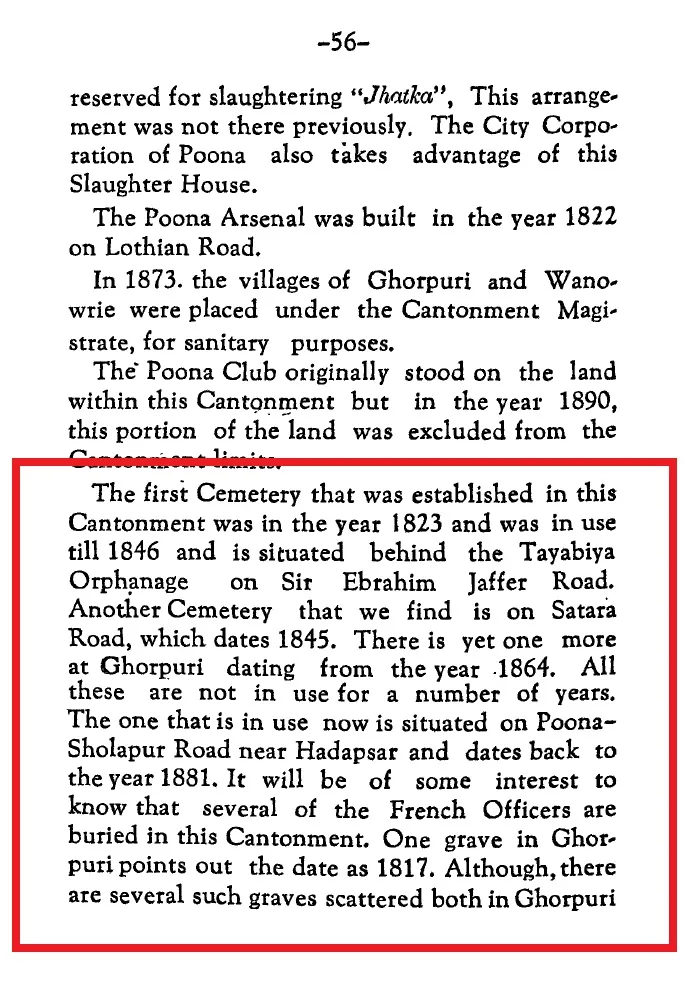
The East India Company established the Poona Cantonment after the Third Anglo-Maratha War in 1818, and the East Street Cemetery came with it. The cemetery is said to have been opened by Mountstuart Elphinstone — who went on to become Governor of Bombay, and after whom Elphinstone College and Elphinstone Road station are named.[4] In the three decades that followed, over two hundred people died and were buried here. By 1881, the Handbook of the Bombay Presidency noted the cemetery was "not well kept" — seven tablets already removed, and the grandest tomb in the ground, a domed structure on six pillars, bearing no inscription at all.[5]
TENTATIVE TIMELINE
- Post-1818 Poona Cantonment established; East Street Cemetery opens
- 1850s Cemetery reaches capacity and falls out of active use
- 1881 Handbook of the Bombay Presidency records it as neglected; seven tablets removed; grandest tomb already unidentifiable
- 1897 ASI records all five European burial sites of Poona under a single entry: "Old European Tombs"
- 1909 East Street Cemetery declared a Protected National Monument
- 1947 Most of the British community departs after Independence; with them goes the last living connection to the people in these graves
- 1990s Graves cleared; plot converted to parking, renamed Kamble Maidan
- 1996 BACSA records the cemetery as "gone completely, levelled of gravestones, rubbish dump"
- 1997 Pune Cantonment Board relocates hawkers to the plot; Fashion Street is born[6]
- 2006 ASI admits to Parliament: 35 protected monuments untraceable; East Street Cemetery among them
- 2024 Remains one of 24 protected monuments completely untraced in India
A Graveyard of Authors
The East Street Cemetery was an unlikely literary resting place. At least three writers of genuine consequence lie here — more than can be said for most cemeteries anywhere in India. They all died young, they all died in Poona, and they all lie beneath a clothing market.
Maria Jane Jewsbury · 1800–1833 · Poet & Literary Critic

In 1832, she arrived in India — newly married, newly hopeful, one of the finest minds Wordsworth said he had ever known. Her works include Phantasmagoria, or Sketches of Life and Literature (1825), Lays of Leisure Hours (1829), and The Three Histories (1830). Within a year of arriving, she was dead in Poona, at thirty-two, of cholera. Her tombstone was engraved with: "Endued with genius, her name lives in the literature of Britain."[5]
Emma Roberts · 1791–1840 · Travel Writer & Editor
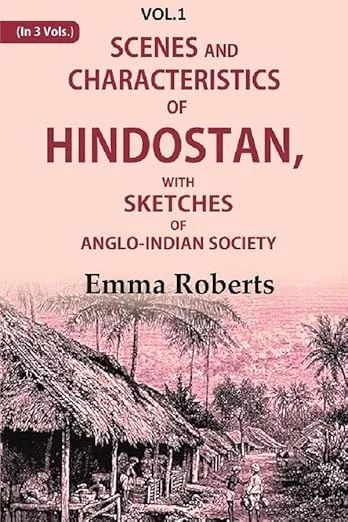
India's first woman newspaper editor — founder of the Oriental Observer in Calcutta, author of Scenes and Characteristics of Hindostan (1835). She died in Poona in 1840, and was buried, as if by design, near Jewsbury. Two women writers of consequence, in the same forgotten ground.[7]
John Augustus Pope · c.1771–1821 · Scholar & Merchant
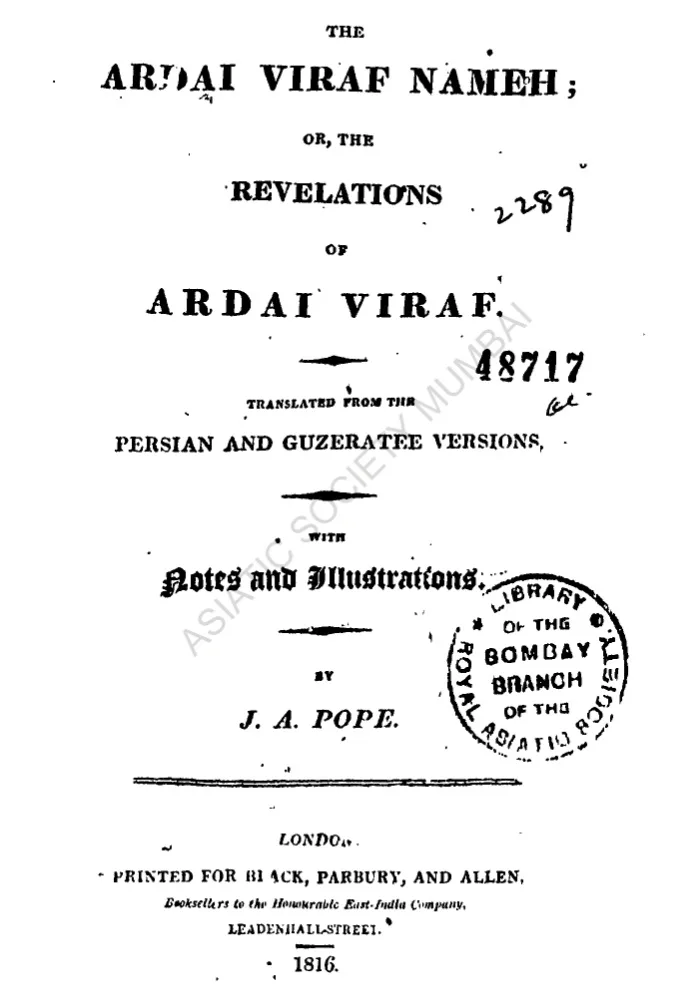
Sheriff and mayor of Bombay, and the first to translate a Zoroastrian text into English — the Ardā Wīrāz Nāmag, patronised by Bomanjee Lovjee of the now-famous Wadia family. When he retired in 1819, Jamsetjee Jejeebhoy — later Bombay's most celebrated philanthropist — hosted a public farewell in his honour. He died in Poona two years later, aged fifty.[8,9]
Anne Alves Arbuthnot · 1829–1830 · Infant
Died at eleven months in 1830. Her father was Collector and Magistrate of Ahmedabad. Her younger brother — born three years later — was Forster Fitzgerald Arbuthnot, who co-produced the first English translation of the Kama Sutra in 1883.[10] Printed under a false name. Read in secret. Reprinted endlessly.
Soldiers, Sons, and the Afghan War
Lt. Col. George Bridges Bellasis · c.1760–1825 · The Convict Officer
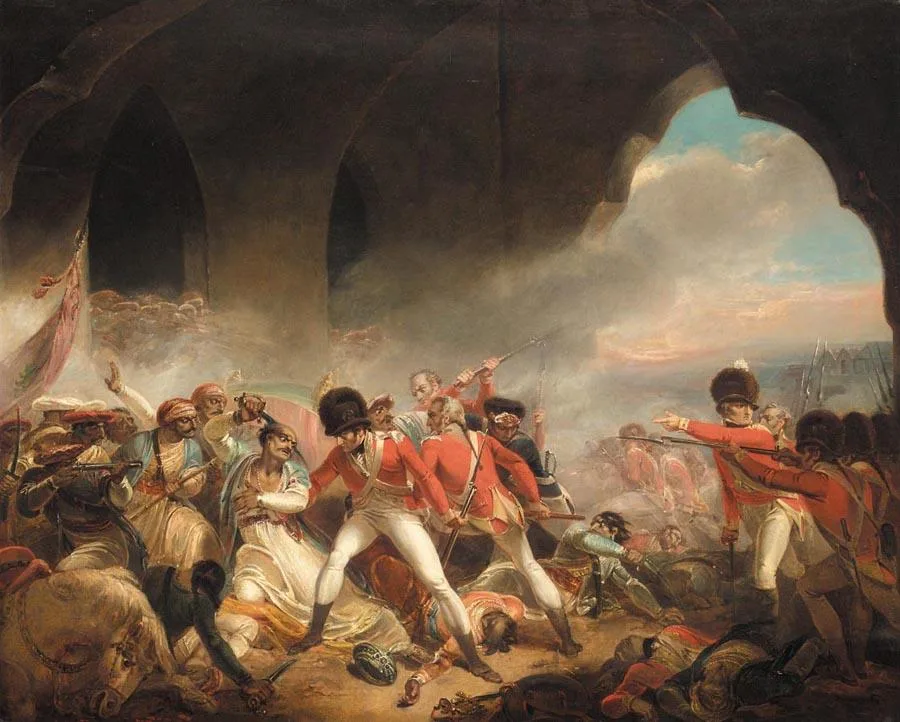
In 1799, Bellasis fought at the Siege of Seringapatam and walked away with a gold ring looted from Tipu's throne and a lock of the Sultan's hair. Two years later, in Bombay, he killed a man in a duel and was transported to Sydney as a convict. He was pardoned in 1803, sailed back, reinstated in the Bombay Artillery, and died in Poona in 1825 as Lieutenant-Colonel Commandant. His cousin, Major John H. Bellasis — son of the officer after whom Bellasis Road in Mumbai is named[11] — is also buried here.[12]
Major Thomas R. Billamore · d. 1840 · The Afghan War Dead
A wife erected one stone for two people lost within five months: her husband, Major Thomas R. Billamore — who died at Karachi during the First Anglo-Afghan War on 27 April 1840 — and their infant daughter, Catharine Margarett, who died in Poona in November 1839. The memorial is the only thing that reunites them. His name is also inscribed on the Afghan Memorial Church at Colaba, Mumbai.[13]
Major John Snodgrass · 1786–1828 · The Man Who May Have Faked His Own Death
John Snodgrass rose to become First Assistant Commissary General in Poona — the officer responsible for the army's entire supply accounts. Arrested for malpractices in 1828, he was said to have shot himself. An inquest was held on a European body whose head was too shattered to permit identification. The Handbook of the Bombay Presidency records that it was "strongly asserted, in more than one quarter, that this officer has since been seen in Europe." The grave may not be empty — but the body in it may not be his.
There are more. The records show ordinary lives cut short: a fourteen-year-old hospital apprentice. A lieutenant dead at twenty-seven. Wives described only as "beloved." The full record, as far as it can be reconstructed from historical journals, is listed in the annexure at the end of this blog.
The Monument That Nobody Could Find
In 1897, the ASI's Revised Lists of Antiquarian Remains in the Bombay Presidency formally recorded the old European burial sites of Poona. The entry for the city's Poona Zilla section reads plainly: "Old European tombs — In and about Poona are some old cemeteries and tombs... Old grave-yard near St. Paul's Church and another in East Street." It was in print. It was official. The ASI knew exactly where it was.[14]
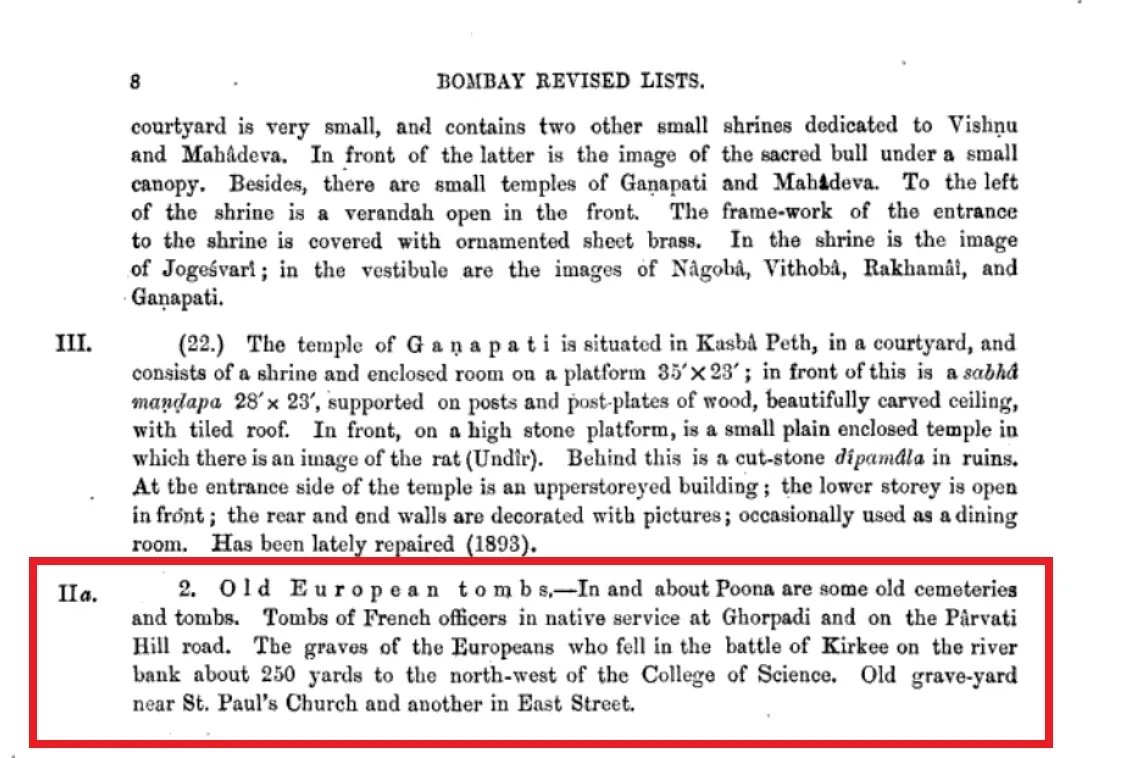
Twelve years later, in 1909, the ASI formally declared the East Street Cemetery — listed under the designation "Old European Tombs" — a Protected National Monument under the Ancient Monuments Preservation Act.[15] On paper, it carries the same legal status as Ajanta, Ellora, and the Taj Mahal.
One Entry for Five Sites — The Fatal Error
But the 1897 listing contained a critical error. Rather than registering each burial ground separately, the ASI bundled all five under one name: Old European Tombs. Five distinct sites. One entry. One protection order. Over time, even that name quietly shifted — from the plural Old European Tombs to the singular Old European Tomb. Once singular, the ASI focused its search on a single location: the Battle of Kirkee Graveyard near COEP on the Mula river bank. A separate site entirely. By focussing solely on Kirkee, the ASI effectively stopped looking for the others.
Those five sites, and their current status:
- East Street Cemetery, Pune Camp — subject of this blog; now Fashion Street
- Garpir Cemetery near St. Paul's Church — still exists, severely dilapidated, trees growing out of graves; widely and wrongly misidentified in popular media as French or German graves[3]
- Battle of Kirkee Graveyard near COEP — cleared, levelled, and built over (based on local accounts; not confirmed by documentary evidence)
- French officers' graves, Ghorpadi — exist but in dilapidated condition; protected only because they fall within Southern Command military premises (based on local accounts). An accident of jurisdiction, not stewardship
- French officers' graves, Shankarsheth Road — likely encroached upon; research ongoing
Five sites. One record. One mistake. And one cemetery that nobody in the ASI was ever even looking for.[16]
Right now, as you read this, a college student is probably negotiating for a fake Nike hoodie at Fashion Street on East Street, Pune Camp — exactly where Lt. Col. George Bridges Bellasis was lowered into the ground in 1825. The air smells of street corn and cheap perfume. No one looks down.
The ASI's predicament was understandable in one way: these monuments had been notified before Independence using names alone, with no precise locations recorded. Decades passed. Records were lost. Land changed hands. By the time anyone looked, nothing was left to protect.
How It Disappeared
Until 1947, there was a living British community in Poona — officers, civil servants, merchants, clergy — who had at least some connection to the people in these graves.
Independence changed that. Most of the British community left within a few years. No descendants remained in Poona. No local family had a relative in the ground. No church maintained a register. No priest made annual visits. The cemetery became, in the most literal sense, an orphan — legally protected on paper, but with nobody left who had any reason to care for it.
"The East Street Cemetery, Poona, again in the middle of Poona, has gone completely, levelled of gravestones, presently used as a rubbish dump for refuse and builders rubble and 'apparently ear-marked by the Municipality for a car park.'" — British Association for Cemeteries in South Asia (BACSA), Chowkidaar, Spring 1996[18]
This is how national monuments disappear. Not through malice, usually, but through a slow withdrawal of the human attention that kept them alive. When the last person who remembered leaves, the forgetting begins.
Fashion Street works. Hundreds of families earn their livelihoods there. A plot that was a rubbish dump in 1996 is now alive with commerce, noise, and the ordinary energy of a city going about its business — and that is genuinely a good outcome. The hawkers didn't take anything from the dead. The dead had already been forgotten long before the stalls arrived. If anything, the market gave this ground a second life.
Cities are always changing. Whatever stands here in the future, what came before deserves to be remembered.
The cemetery cannot be restored, and nobody is asking for that. But if the ASI is serious about accountability, here is what it should do:
- Reclassify Old European Tomb (singular) back to Old European Tombs (plural), as originally recorded in 1897 — acknowledging that five distinct sites were always involved
- Conduct individual assessments of each site
- Delist what has genuinely been lost: the East Street Cemetery and the Battle of Kirkee Graveyard
- Actively protect what still exists: the Garpir Cemetery near St. Paul's Church, and the French officers' graves at Ghorpadi and on Shankarsheth Road
- For the delisted sites, commission memorial signboards at the original locations
A memorial signboard at Fashion Street costs almost nothing. A woman Wordsworth called one of the finest minds he had ever known, dead of cholera in Poona. A soldier who walked away from Seringapatam with Tipu Sultan's gold ring and a lock of his hair. An infant whose brother would go on to give the world the Kama Sutra. And a man whose grave may not contain the man it names. These are the stories this ground holds. That is the least we owe it — to say so.
Should this place be marked and acknowledged for what it is? If this blog made you see a familiar stretch of Pune differently — tag a friend who has bought clothes at Fashion Street, and share it with them.
Bibliography
- Comptroller and Auditor General of India. Report No. 18 of 2013 — Performance Audit of Preservation and Conservation of Monuments and Antiquities, Ministry of Culture. cag.gov.in
- Parliamentary Standing Committee on Transport, Tourism and Culture. 324th Report — Issues Relating to Untraceable Monuments and Protection of Monuments in India. Rajya Sabha, December 2022. rajyasabha.nic.in. See also: "ASI Plans to Delist 18 Untraceable Monuments." Scroll.in, 25 March 2024. Link
- Gazetteer of the Bombay Presidency, Vol. XVIII — Poona (1885)
- "Stroll V." Bombay Miscellany, Chesson & Woodhall, Vol. VIII (May 1864)
- Handbook of the Bombay Presidency (1881)
- "Fashion Street Hawkers Relocation Now a Headache." Indian Express. Link
- Bullock, H. "Monumental Inscriptions: Poona, East Street Cemetery." Bengal Past and Present
- Bullock, H. "Some Epitaphs at Poona (East Street Cemetery)." Notes and Queries, Vol. 161, No. 17 (1931)
- Bulley, Anne. Free Mariner. BACSA, London (1992)
- Arbuthnot, F.F. & Burton, Richard F. (trans.). The Kama Sutra of Vatsyayana. Kama Shastra Society, London (1883)
- Sheppard, Samuel T. Bombay Place-Names and Street-Names (1917)
- "Bellasis, George Bridges." Australian Dictionary of Biography. Australian National University
- Revised List of Tombs and Monuments of Historical or Archaeological Interest in Bombay and Other Parts of the Presidency (1912)
- Burgess, James & Cousens, Henry. Revised Lists of Antiquarian Remains in the Bombay Presidency. ASI (1897)
- ASI Western Circle Progress Report (1909)
- "ASI Looks for Missing Old European Tombs." Times of India, 5 September 2013. Link
- Moledina, M.H. History of Poona Cantonment (1953)
- British Association for Cemeteries in South Asia. Chowkidaar, Vol. 7, No. 5 (Spring 1996)
Acknowledgements
This article is the result of over nine months of research, carried out alongside my primary work in real estate development. I am grateful to the following people for generously giving their time, support and knowledge to help bring it together: Wayne Mullen, author of Deccan Queen: A Spatial Analysis of Poona in the Nineteenth and Early Twentieth Centuries; historian Sanjay Deshpande; my uncle Jatin Chheda; Jui Tawade, Co-Convenor of the INTACH Pune Chapter; and the John Rylands Research Institute and Library at the University of Manchester.
Epitaphs: East Street Cemetery, Poona
Inscriptions recorded by H. Bullock in Bengal Past and Present and Notes and Queries (1931) — a partial record of the 231 monuments recorded in the 1885 Gazetteer.
Full list of known epitaphs (click to expand)
In 1816, Pope produced the first English translation of the Zoroastrian text Ardā Wīrāz Nāmag, patronised by Bomanjee Lovjee of the Wadia family. When he retired in 1819, Jamsetjee Jejeebhoy hosted a public gathering in his honour. His letters about a mariner's life in the East Indies were later compiled into Free Mariner by Anne Bulley (BACSA, 1992).
Fought at the Siege of Seringapatam in 1799. Convicted of manslaughter in Bombay in 1801 and transported to Sydney, Australia. Appointed to an official role in the colonial government before being pardoned in 1803. Returned to India and rose to Lieutenant-Colonel Commandant of the Horse Brigade of Artillery.
Arrested for malpractices in 1828. Recorded as having shot himself; an inquest was held on the body of a European whose head was too shattered to permit identification. The Handbook of the Bombay Presidency notes it was "strongly asserted, in more than one quarter, that this officer has since been seen in Europe." The body in this grave may not be his.
Her younger brother, Forster Fitzgerald Arbuthnot (1833–1901), co-produced the first English translation of the Kama Sutra with Sir Richard Burton in 1883.
The name is recorded as "Law" in H. Bullock's Notes and Queries transcription, but as "Lang" in the Bombay Presidency source — a transcription discrepancy between the two primary records.
A close friend of William Wordsworth, who described her as having "one of the finest minds" he had ever known. Died of cholera in Poona aged thirty-two. Her husband, the Rev. William Kew Fletcher, rose to Archdeacon of Bombay; a tessellated pavement inside St. Thomas's Cathedral, Fort Mumbai, is dedicated to him.
Killed in a duel at Poona by Asst.-Surgeon John Porter Malcolmson of the Bombay Army. The cause of the duel was the surgeon's own wife. Tried for murder before the Bombay Supreme Court on 25 September 1835; the surgeon offered no defence. The jury foreman announced their acquittal before the judge had finished his charge. Urquhart's brother officers paid for the stone. The surgeon survived.
She died not in the cantonment but in camp — on military manoeuvres near Poona. Her husband's stone records that she left behind children. The phrase "he and her children" is one of the few epitaphs in this cemetery to acknowledge surviving dependants by implication.
Major Billamore died at Karachi during the First Anglo-Afghan War. His name is also inscribed on the Afghan Memorial Church, Colaba, Mumbai. His brother Captain Frederic Hadow Billamore's infant son, Lestock Baber, is also buried in this cemetery.
A Bengal Army officer buried in Poona — likely on temporary attachment or passing through the Bombay Presidency station.
First woman newspaper editor in India — founder of the Oriental Observer in Calcutta. Author of Scenes and Characteristics of Hindostan (1835). Buried near Maria Jane Jewsbury.
Her father, Saville Marriott, was a published author on India — he wrote India: The Duty and Interest of England to Inquire Into Its State — and appears in Mountstuart Elphinstone's private correspondence at the British Library (Mss Eur F88), in the same volume as applications from Robert Keith Arbuthnot and Colonel GB Bellasis, two others buried in this cemetery. Jane Mary died in Poona at thirty, leaving behind her husband and, by implication, children.

14 Comments

A powerful and thought-provoking piece—especially for a first blog. What stayed with me most is not just the imagery of a forgotten graveyard, but what it represents: how easily chapters of history can slip into silence.
In a country like India, where layers of history overlap so densely, that it makes one wonder how many narratives—of people, places, and moments—have quietly disappeared with time.
Your first blog, is a deep reflective start, reminding us that history isn’t just what is written, but also what is forgotten….. Author
Thank you for your words of encouragement. ‘History isn’t just what is written, but also what is forgotten’ -you’ve said it better than I did in the entire article.

This is honestly shocking. A protected monument just… disappearing under a marketplace says a lot about how we treat history..
This is incredibly well written, especially for a first blog. The way you’ve woven history with storytelling keeps the reader hooked throughout.
A Voice from Beneath
Reading this, I couldn’t help but imagine what one of those buried here might say:
“We were never lost—only forgotten. You chose to look where others didn’t, and in doing so, you gave us back our place in memory.”
A powerful piece, Rahul. Thoughtful, precise, and deeply felt. Grateful for the mention.
- Author
‘We were never lost – only forgotten’ is the line the entire article was trying to say. Thank you for always being part of the journey…

The blog by an IITian is truly mind-blowing. He has gone beyond the depth of not so old history, and opened the door for the ASI to put more efforts to establish and identify such monuments, not limited to Pune, but other places in Maharashtra, particularly the very much ignored Khandesh and the Tapti Valley.
Wish you all the best for your blogspot. Keep going.
A wonderfully researched and beautifully written history of the graveyards in Pune Cantonment. I have been to Fashion Street on several occasions, during my tenure in Southern Commmand. I would never have imagined that the market stood over an old British cemetery! Just as an aside, there exists a Pet Cemetery as an adjunct to an old Christian Cemetry somewhere on Salisbury Road(may not be within the precincts of the Cantonment) where we laid our family’s beloved black labrador, “Peanut” to rest a few years ago.
- Author
Thank you sir, I have the Salisbury Park Cemetery on my radar, will cover it soon.

Beautifully written — haunting, yet makes you appreciate how layers of history exist in our cities.
This gave me goosebumps, Rahul! To think we casually shop, eat, and click selfies on land that once held so many stories and farewells. You’ve turned a regular shopping trip into something profound.
We walk into these bright, bustling malls and never pause to think about what lies beneath. The way you connect history, urbanization, and our everyday habits really makes you stop and reflect. History isn’t buried — we’re living right on top of it.
Great read! Thank you for writing this.
- Author
‘History isn’t buried – we’re living right on top of it.’ You just wrote the line I was looking for when I started this article. Thank you!

Great work !
Even I always had this curiosity of the English who lived in our cities and what happened to their things when they left….
Truly remarkable research. Like many, I too never knew & thought such a thing of great heritage value exists underneath the market of today. 9 months of research brought to the surface the forgotten names. You should approach the ASI for restoration of city’s heritage site/s with your work.
Highly appreciate your research work in identifying the untraceable sites despite the highly time demanding real estate sites you’re currently building.
Excellent . Admire your passion and efforts in doing this painstaking research. I have also grown up in Pune Camp and I have seen this cemetery when I was in my teens ( i am 70 now). As you have rightly mentioned that no one had any connection and interest so it become dilapiated. It is not that Fashion Street was established out of ignorance of cemetery. The Pune Cantonment Board was aware of the situation but street vendors managed to get some political support and decision was made. You may be able to find more from records of PCB. Local newspapers did carry out a debate about this issue. We had a daily newspaper called Poona Herald which was published from a building across the cemetery. I do not know whether in any archives of this newspaper are available. Check with Sakal. They acquired this newspaper which later on became English edition of Sakal.
Try to find out some people who are in 80s-90s and have grown up in that area.
I know two families but older generation has gone and current generation is of my age.
All the best for such future endevours.
Raj Hirwani, Ph.D (IITB)
Rahul, what a fascinating read.
‘When the last person who remembered leaves, the forgetting begins.’ Lovely.
I especially like that you acknowledge the loss of this piece of history but recognise that the living present is as important and go on to suggest how we might keep the memory alive.
It leaves one with a tinge of sadness for those forgotten but puts our own lives here in perspective. Ashes to ashes, dust to dust. Life continues, and so it must be.